Maybe you owe someone money, but they decide to cancel your debt. You may have hurt someone you love, but you were given another chance. You may have made a huge mistake, but instead of being punished, you received forgiveness.
In the fifth of the Beatitudes, a series of promises that Jesus made about the Kingdom of God, Jesus said the following:
“Blessed are the merciful, for they shall be shown mercy.” Matthew 5:7
Because we are all imperfect sinners who fall short of God’s glorious standards, we all deserve to die. We all deserve to be punished. We all deserve eternal separation from God.
“But God, who is rich in mercy, because of His great love with which He loved us – we, who were dead because of our transgressions, made us alive together with Christ, because you are saved by grace.” Ephesians 2:4-5
Jesus is passionate about justice and righteousness, and at the same time passionately loves grace and mercy. That’s why He paid the ultimate price for us—so that we could truly live. That is why He conquered death—to mercifully save our souls. That’s why He sent His Spirit—so that we too can show mercy.
To be clear, grace and mercy, while similar, are not the same thing. Grace is getting what you don’t deserve (an undeserved gift) and mercy is getting what you deserve (judgment and wrath).
And although it is easier said than done, His people are called to be merciful. Even when someone has hurt you. Yes, even when they don’t deserve your kindness. Yes, even when you don’t feel like being merciful.
Jesus showed us mercy. What now? We can recommend it to others.
Prayer
God, it is Your nature to offer mercy. When people meet me, I want them to know that You live in me. Give me the ability to show Your mercy to those around me. As my faith grows, please give me a deeper ability to offer mercy to others. In Jesus’ name, Amen.
The Concept of the Prayer Marathon: A Lesson from the Prophet Daniel
In our spiritual life, we often encounter periods of silence when answers to fervent prayers are delayed. However, the Word of God reveals to us an important secret of the spiritual world through the experience of the prophet Daniel. After mourning and fasting for three weeks, he saw no visible change, as the scriptures state:
“I did not eat my favorite food, I did not even put meat or wine in my mouth, I did not anoint myself with incense until the three weeks of days were over” (Daniel 10:3).
But the spiritual reality turned out to be completely different. The Angel of the Lord, appearing to him, spoke words that should become a fundamental encouragement for each of us:
“Do not be afraid, Daniel, for I have from the first day that you decided to understand, humbling yourself before your God, your words have been heard, and because of your words I have come” (Daniel 10:12).
The main truth is that God gives an answer at the very moment when we make a decision in our heart to humble ourselves and cry out to Him. The problem is already solved in heaven, but on our earthly level there is a time interval (timing) that is different for everyone: for someone it is three days, for someone it is years. Our task is not to stop, run this marathon of faith and fulfill the commandment “pray without ceasing”, because the time of the answer is known only to the Creator.
Stand in the breach for the servants
We live in difficult times when everyone is tempted to withdraw, move away or hide from the challenges of society. However, God sovereignly placed His people right here to shine in the midst of darkness in Ukraine. We have a shared responsibility for the prayerful support of our bishops, pastors and their families. Even when we don’t see immediate results, the prayer of faith works. We ask for special grace, God’s protection from spiritual attacks, financial support, restoration of physical strength and strength of family relationships for those who have dedicated themselves to serving the Church.
The prophetic calling of the next generation
Turning to the prophecy of Joel, quoted by the apostle Peter, we see God’s unique view of the structure of society:
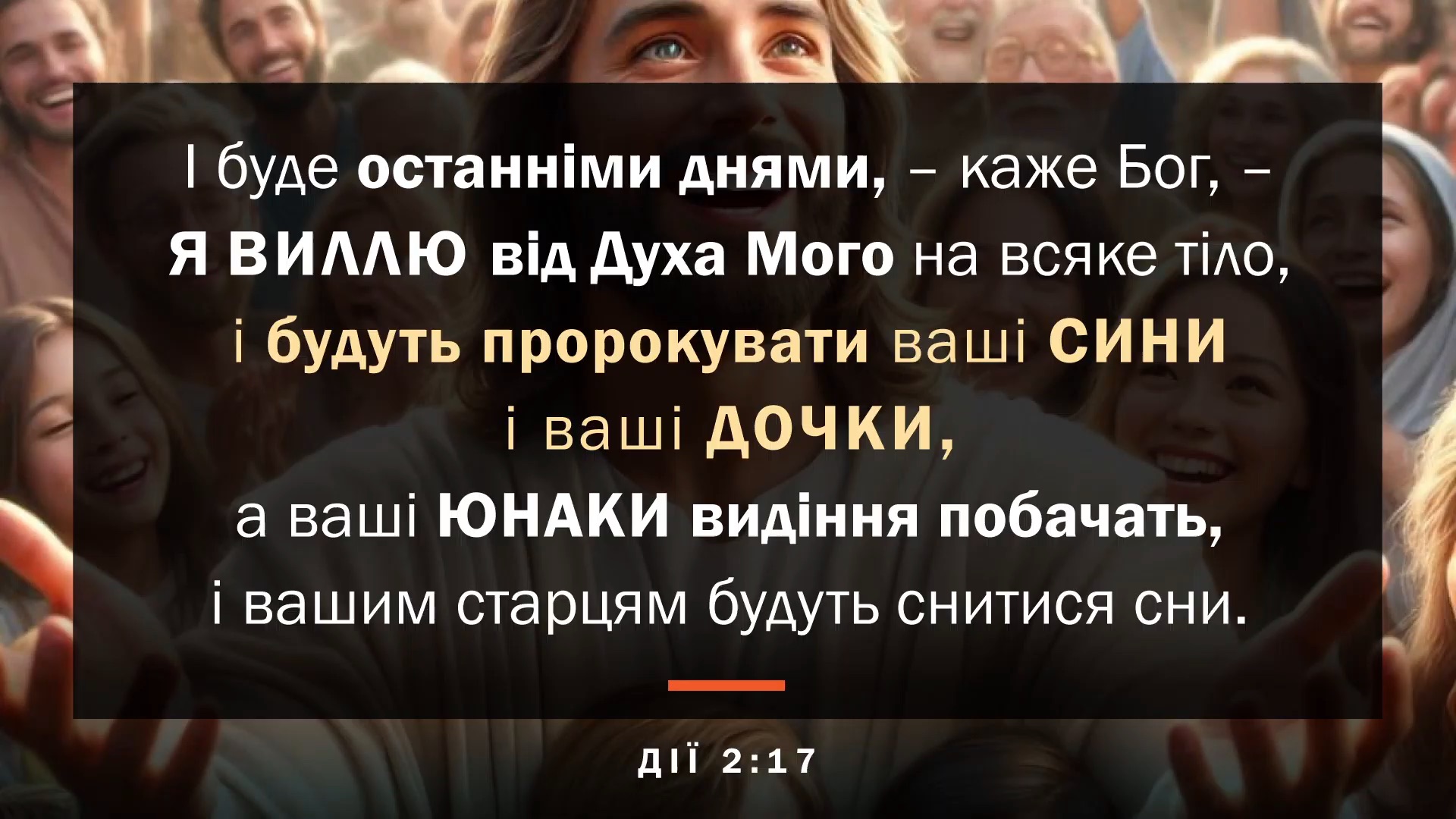
“And it will be in the last days, says God, I will pour out my spirit on all flesh. And your sons and your daughters will prophesy, and your young men will see visions, and your old men will dream dreams” (Acts 2:17).
Human psychology tends to neglect extreme age categories: children and young people often have no real influence on the processes in the state and are forced to reap the fruits of other people’s decisions, and the elderly face domestic disrespect. But God destroys these stereotypes. It elevates the youth and the elderly, giving them strategic importance.
The older generation is called to be a support in prayer and to give wise advice. Instead, the mission of children, teenagers and young men is to become God’s prophets for our country. To prophesy is not simply to predict the future, but to speak God’s truth uncompromisingly to people in authority, neighbors, parents and peers, pointing out righteousness and exposing iniquity.
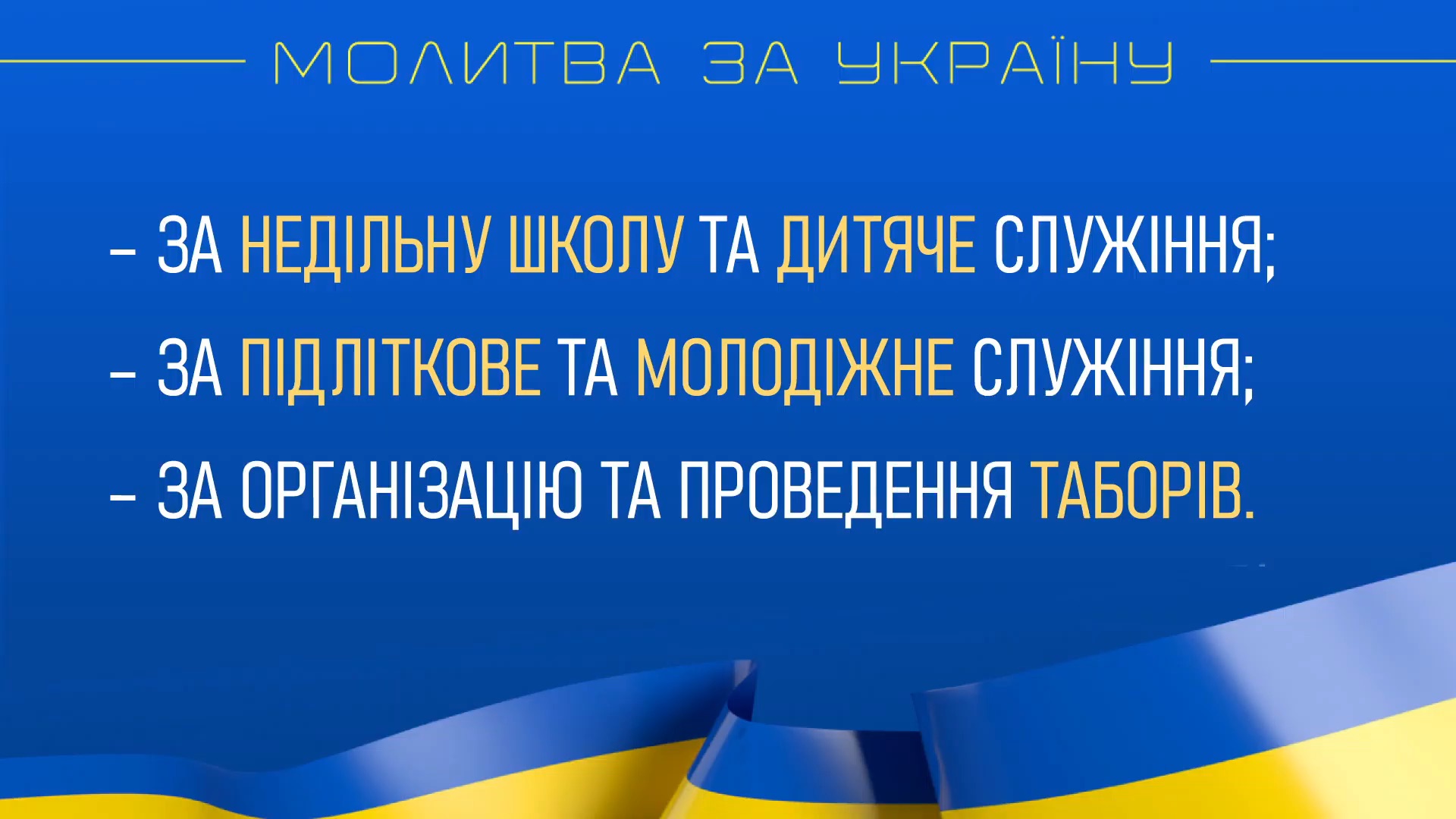
These prophets will not fly from outer space and come as foreign humanitarian aid – they must grow within our church. We, as the older generation, are obliged to help them experience a personal encounter with the Creator through active services and Christian camps.
The Integrity of Christian Influence: Today’s Challenge
The recent tragedy in Kyiv on Chokolivsky Boulevard, where the driver of a Mercedes drove into an underpass and killed four people, became a painful but sobering lesson for us. The horror of the situation is enhanced by the fact that the perpetrator of the accident in the past (or now) was a church pastor from the currently occupied Kherson region, who had numerous systematic violations of traffic rules and the law over the past year.
This unfortunate incident raises the question of our true influence. We must be the same both inside the walls of the church and outside them. If a person called to save souls brings death and lawlessness with his lifestyle, this is a deep spiritual deformation. We strive to be a Church through which people come to know salvation and not perish. Our daily choices and obedience to the law are also part of our preaching influence.
The Holy Supper: Consecration and Power for Change
The commandment of the breaking of bread takes us back to the events of the Passover Seder, where Jesus established the New Testament:
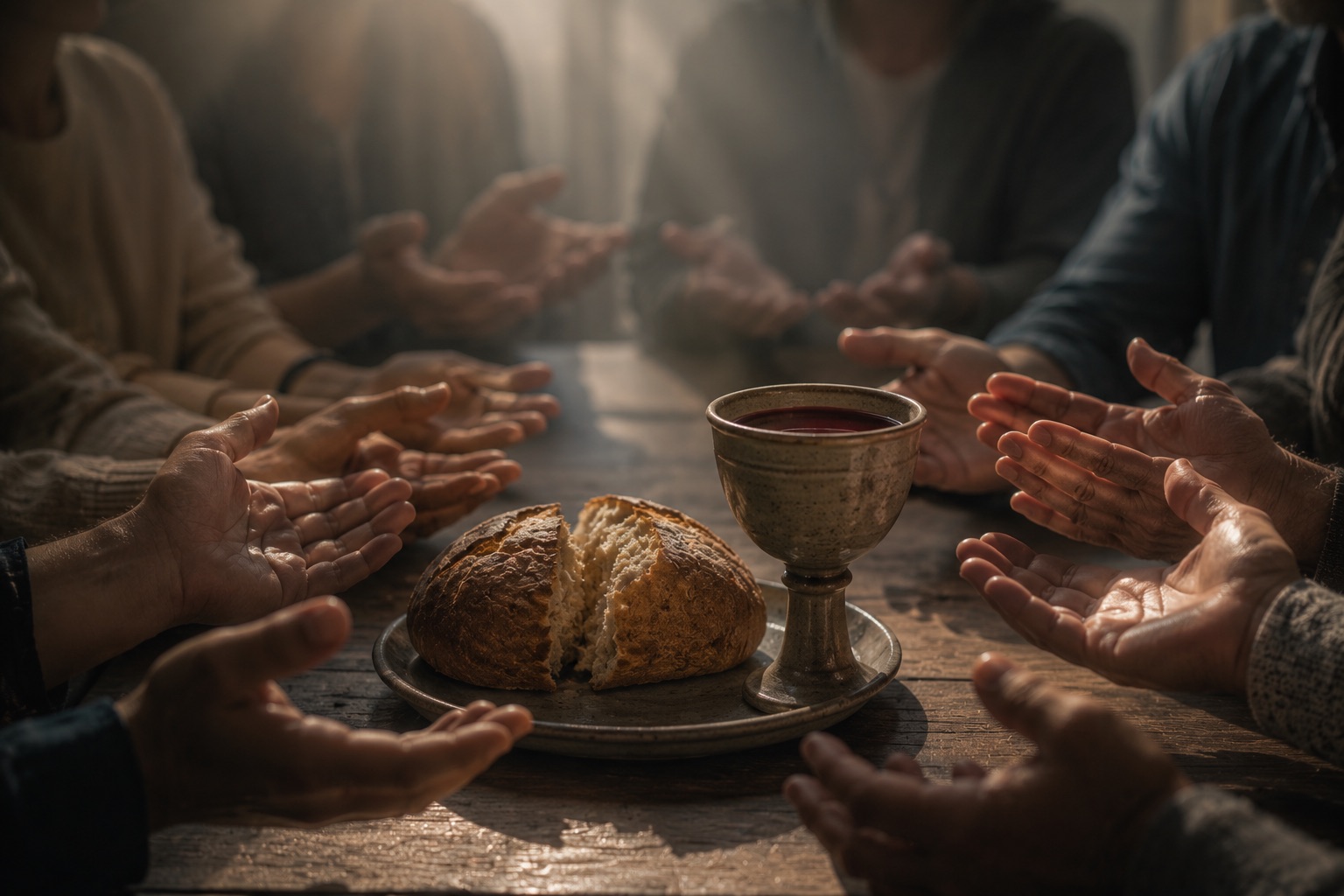
“When they were eating, Jesus, taking bread and blessing, broke it and gave it to the disciples and said, take, eat this, this is my body. Then he took the cup and, giving thanks, gave it to them and said, “Drink from it, all of you, for this is my blood of the new commandment, which is shed for many for the forgiveness of sins” (Matthew 26:26-28).
These two symbols have a deep practical meaning:
Bread (Body) is a reminder that the highest price was paid for our salvation. We don’t have a second or third life. We have only one earthly attempt, and the choice is ours: dedicate it to God and service to people or just aimlessly drift with the flow.
Cup (Blood) is a testimony of the forgiveness of our sins and reconciliation with the Father. Only through Christ we receive the supernatural power to live a holy life and be a blessing to society.
🗓️ Upcoming events and service schedule
Weekly schedule:
Every Monday at 19:00 — Church-wide prayer service (our common vocation and influence on the spiritual atmosphere).
During the week – Home groups (time for communication, analysis of the Word and mutual support). Do not miss meetings in your areas!
Every Sunday at 10:00 — Joint Sunday service of the church.
🙏 Prayer Challenges
Calendar of special events and summer projects:
June 21 (Sunday) — Anniversary of our sister church in the village of Pustovarivka We invite everyone to support the community of Anna Mykolaivna Gajdarenko. Departure is planned immediately after our morning service, transportation is provided by the church.
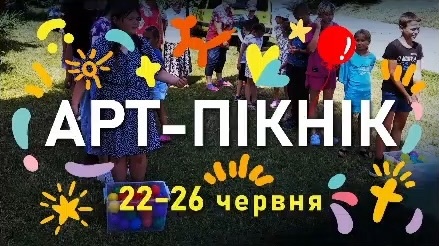
June 22 – 26 (The penultimate week of June) — Children’s “Art-Picnic” in park named after Potapov. Time: from 15:00 to 18:00/19:00. In the program: games, trampoline, creative workshops for children of the district. (For questions about volunteering and help, contact Yulia Koltukova).
June 29 – July 3 – 5-day children’s camp in the village of Pustovarivka on the theme “Pilgrim’s Journey”. We need prayer support and helpers for the team.
July 15 – 18 — 4-day tent camp for children, teenagers and young people on the Kyiv Sea. Important: we earnestly pray for good weather without showers. 🔥 1 vacancy for a kitchen attendant is open (opportunity to serve and relax in a friendly circle).
The context of Pentecost and the double meaning of biblical holidays
We congratulate the dear church and all who join together in joint worship online or view this word on record, with the great feast of Pentecost – the Descent of the Holy Spirit. God always keeps His promises flawlessly. Before His ascension, the Lord Jesus Christ left a clear assurance to the disciples, written in The Book of Acts: “You will receive power when the Holy Spirit comes upon you, and you will be my witnesses in Jerusalem and Judea and even to the ends of the earth”. This is exactly what happened on the fiftieth day.
Each biblical holiday established by the Creator has a deep double meaning: historical and national for Israel and spiritual, prophetic for the New Testament Church.
Typology of the three main feasts of the Lord:
Passover (Pesach): For Israel, it is a way out of Egyptian slavery; for us – redemption by the Blood of Jesus Christ from the spiritual slavery of sin.
Pentecost (Shavuot): For Israel, it is the feast of the first fruits and the day of the giving of the Law through Moses at Sinai; for us it is the day of the Descent of the Holy Spirit, the birth of the Church and the gathering of the first spiritual fruits in the number of three thousand repentant souls.
The Feast of Tabernacles (Sukok): A reminder of the 40 years of wandering in the desert and living in temporary tents. This is an image of the fact that we on this earth are travelers and sojourners who are temporarily in the ravages of our earthly bodies. This is the only holiday that will receive its absolute consummation in heaven, in the Kingdom of God, when we reach the Promised Land and enter our permanent heavenly abodes.
The impasse crisis and the fundamental question
In everyday life, we regularly encounter circumstances that drive us into a dead end. When the usual methods do not work, problems are not solved, and human resources are exhausted, a cry is born inside us: “What should I do?”. Human nature tends to look for salvation in a crisis, to make promises to God, but to forget them as soon as the danger passes – like a traveler who got lost in the forest, prayed for salvation, and took the appearance of a forester as a coincidence, canceling his vow to the Creator. However, true deliverance is never a coincidence—it is always a sovereign act of God. In order to get out of the spiritual impasse, it is necessary to hear the truth that was spoken more than two millennia ago in Jerusalem.
Sermon of the Apostle Peter: Three dimensions of Christ’s mission
When the Holy Spirit descended on the disciples in the upper room, accompanied by the noise of a strong wind and speaking in other languages, the crowd of pilgrims was shocked to hear the preaching of God’s great works in their own words. Refuting ridiculous accusations of drunkenness, the apostle Peter preached the first New Testament sermon, which is the foundation of the Church.
“Men of Israel, listen to these words: Jesus of Nazareth, the Man about whom God testified to you by mighty manifestations, miracles and signs that God did through Him among you, as you yourselves know, Him, delivered according to God’s design and prediction, you killed, nailing to the cross with the hands of lawless men. But God resurrected Him, freeing Him from the torment of death, because it was not in her power to hold Him.”
This text reveals to us three pillars of our confidence:
Jesus is the only Messiah and Savior: His mission was authenticated by God through supernatural signs and wonders. There is no other name under heaven by which man can be saved. Each of us must be 101% sure of our personal salvation through Christ.
Crucifixion is God’s sovereign plan, not the victory of evil: Christ’s death on Calvary was not a tragic accident. It was God’s eternal providence for the atonement of our sins. Even when it seems that evil is temporarily victorious (as the Pharisees and Romans thought when they put Jesus in the coffin), God turns it into a triumph.
Resurrection is the guarantee of our victory over death: Death had no legal and spiritual right to restrain the Author of life. The resurrection of Christ gives us a clear answer to the question “what happens after death?”. For a believer, physical death is not an end, but a door that opens to eternity, where there are no more tears, pain and wars.
Awareness of personal guilt and heartbreak
Peter’s sermon reaches its climax when he translates a historical fact into the plane of personal responsibility of each listener:
“Therefore, let the whole house of Israel know for sure that God has made Him, this Jesus, whom you crucified, both Lord and Christ. When they heard, they were moved in their hearts and said to Peter and the other apostles: What should we do, men and brothers?
We are no better than those people who shouted “crucify me” in front of Pilate’s praetorium. Every sin of ours, every doubt, every rejection of God’s word is a nail driven into the hands of the Savior. We have personally crucified Christ with our iniquity. And when this realization shatters our human pride, the correct, saving question is born: “What should we do?”. If we are sincere, God will never leave us unanswered.
Three steps of God’s response: Repentance, Baptism, Gift
The Apostle Peter gives a comprehensive algorithm of actions for getting out of a spiritual dead end and entering into supernatural God’s blessing:
“And Peter said to them: Repent, and let each one of you be baptized in the name of Jesus Christ for the forgiveness of your sins, and you will receive the gift of the Holy Spirit. After all, this promise is for you and for your children, and for all those who are far away, whom only the Lord our God will call.”
Our relationship with the Creator always starts with the recognition of our own spiritual inability. As long as a person thinks he is “fine,” he is like a patient who hides his symptoms from the best doctor, making healing impossible. Repentance is a complete change of mind and a confession: “I am a sinner in need of salvation.”
Step 2: Water baptism
It is a public, visible covenantal step that affirms and testifies to the spiritual and physical worlds of our conscious choice to follow Jesus Christ by dying to sin and rising to holy living.
Step 3: Accepting the Gift of the Holy Spirit
We are powerless to fulfill God’s will and His mission with our own human resources. Even the apostles were passively waiting until they were clothed with power from above. The Holy Spirit is not a reward to be earned by years of perfect behavior or religious experience; it is a GIFT (gift). The task of the believer is to gratefully open his heart and receive this kindling of Divine power.
The steadfastness of God’s promises
The enemy of the human soul tries to sow doubt by whispering that God’s promises belong only to the elect, perfect or holy people. However, the Word of God clearly declares: the promise of strength, protection, healing and restoration belongs to:
To you personally;
To your children and future generations;
To all those who today are still far from God and the Church, but whom the Lord will call.
All the promises of God in Christ Jesus are Yes and Amen. No external circumstances, inclement weather, or enemy machinations can stop the fulfillment of God’s word if we are in His presence.
Summary and practical embodiment of the truth
When we receive Christ, we receive the fullness of God’s grace: forgiveness, release from the shackles of the past, and the supernatural guidance of the Holy Spirit. Our responsibility today is not to remain passive listeners, but to act on the word we receive.
A practical schedule of the life of our community:
🙏 Prayer for the country: Every Monday at 19:00 we gather together for fervent prayer for the end of the war and the establishment of a just peace in Ukraine.
🏠 Small groups: During the week, be sure to visit home groups for deeper unity and mutual spiritual support.
🍞 Breaking of Bread: Next Sunday we will hold a prayer service with the commandment of the Holy Supper (breaking of bread). Be sure to invite those who were not around today.
Remember: God’s hand has not shortened to save, and His ear has not become deaf. He is the same yesterday, today and forever. The promise is left just for you – accept it and be blessed in His peace!
Entering the church hall, where the music was solemnly playing, I looked around to see the people who had gathered for the evening service dedicated to the meeting of the New Year. I remembered the events of the past year, and my heart was filled with joy and hope. We grieved together over lost children, the death of loved ones, the loss of some jobs, and broken relationships. But at the same time, we came to know God’s grace. We also celebrated victories, weddings, successful graduations from educational institutions, baptisms, through which new members were added to our church family. We also rejoiced at the birth of babies, the adoption of children and the consecration of young children to the Lord. And many other things were wonderful and comforting. Reflecting on the history of our church, I, like Jeremiah, although I remembered “trouble and torment” (Lamentations 3:19), firmly believed that “it is the Lord’s mercy that we did not perish, because His mercy did not end” (Lamentations 3:22). The prophet relied on God’s faithfulness in the past: “The Lord is good to those who hope in Him, to the soul that seeks Him!” (Lamentations 3:25).
That evening, every person in the meeting was a visible proof of how God’s love transforms us. And whatever befalls us in the coming year, we can firmly rely on the Lord and strengthen our hope through memories of God’s unchanging character.
Lord, thank you for using our past to strengthen our confidence that our hope is guaranteed by your eternal faithfulness. As we look into the new year, let’s not forget that God has always been and will be faithful. Author: Sosheel Dixon
Intersection of human questions and God’s sovereignties
We live in an era of global uncertainty, when the heart of every person in the epicenter of trials or war is pierced by the same question: “When?”. When will the finals come? When will visible release come? This desire to look behind the veil of the future, to know the precise terms and chronology of God’s actions is absolutely natural for human nature. However, the truth of God’s Word shifts our focus from passively waiting for dates to actively fulfilling the mission.
On the eve of the great feast of Pentecost – Trinity, when we remember not only the giving of the Law (Shavuot) to Moses on Sinai, but also the double blessing of the New Testament – Holy Spirit, we must clearly distinguish between what belongs to the exclusive authority of the Creator and what is delegated to us as His Body on earth.
Verse seven: What is NOT our business?
Turning to the text of the First Chapter of the Book of the Acts of the Holy Apostles, we see the disciples who have just passed through the crisis of the crucifixion and the triumph of Christ’s resurrection. Their thinking still remains within the framework of national-political liberation. They ask: “Aren’t you going to rebuild the kingdom of Israel at this time?”. They seek to know the end of the Roman occupation and the restoration of sovereign statehood. Christ’s answer sounds radical, almost harsh, sobering their perception:
“And He said to them: It is not your business to know the time and the day, which the Father has put in His power.” Acts 1:7
If we honestly ask ourselves today: “Would we like to know exactly the day and hour when this grueling war in Ukraine will end?”. Each of us would raise our hand. We seek control over time, because control gives a false sense of security. However, the Word of God tells us right in our eyes: “It’s none of your business”.
Knowing the precise time limits of global historical events, geopolitical shifts, or God’s final judgments is an area that Heavenly Father has sealed with His own sovereign authority. When we spend our emotional and spiritual resources trying to calculate dates, we are wasting potential to fulfill our mandate.
Eighth verse: What IS our business?
God never leaves man in a vacuum of inactivity. By closing the door to the mysteries of His schedule, He opens wide the door to our practical responsibility. If knowing the times is not our business, then what is our direct duty? The answer is found in the following verse:
“But you will receive power as the Holy Spirit comes upon you, and you will be my witnesses in Jerusalem, and in all Judea and Samaria, and to the ends of the earth.” Acts 1:8
It is our job to embrace supernatural power (dynamis) and witness. Jesus outlines a clear geographical and spiritual sequence that has direct relevance to our present:
In Jerusalem: This is our immediate environment, our home, our hometown (for us it is Kyiv). A place where we are known best and where our testimony is tested by daily character.
Throughout Judea and Samaria: This is stepping outside the comfort zone. Judea is the broader context of our culture (all of Ukraine), and Samaria is an environment of people who may be religiously, socially, or ethnically alien or even hostile to us (historically, the Jews had no relations with the Samaritans). But God’s power overcomes these barriers.
To the ends of the earth: This is a global missionary mandate. From the point of view of the first century, the territories of modern Ukraine were on the periphery of the known world, that is, we are literally the fruit of the same fulfillment of Christ’s command and now we ourselves must pass this baton on.
Practical implementation: Three vision vectors for 2026
In order for the biblical concept of “being a witness” not to remain an abstract theological theory, it must be embodied in clear, measurable steps of the local church. Our shared vision for this year 2026 is a direct reflection of Christ’s mandate:
📌 1. Personal evangelization: I personally lead at least one person to Christ this year. This is not the task of individual “gifted” evangelists or pastors – it is the personal mission of everyone who has experienced salvation.
📌 2. Home church: All people in the radius of my daily life (neighbors, colleagues, acquaintances in the yard or at the entrance) know that I believe in Christ, see my concern and hear my testimony.
📌 3. Scaling: Our local church opens at least one new daughter church, spreading God’s Kingdom further.
It is quite natural if when looking at these goals, fear, insecurity or the thought arises inside: “I can’t speak well, I’m afraid of rejection, it’s not for me”. Even Christ’s disciples felt this way. But that is precisely why Jesus does not send us to this ministry on our own.
The Methodology of Christ: The Seventy Disciples and the Scaling Principle
To prove that the mission of the gospel belongs to the whole community, and not only to an elite circle of leaders, let us turn to the Gospel of Luke:
“After that, the Lord also appointed seventy others, and sent them two before Him to every city and place where He had to go. And he said to them: The harvest is great, but the workers are few; so beseech the Lord of the harvest to send laborers into His harvest.” From Luke 10:1-2
Pay attention to the phrase: “and seventy others”. At that time, there were already twelve chosen apostles who had authority and experience. But Jesus attracts ordinary, wider followers. He sends them to “where He was supposed to go”. Christ was in a human body and could not physically be in two places at the same time. Today His Body is us. We become His feet, His hands and His voice in those offices, offices, hospitals and homes where a Pastor or an official minister can never enter.
Three consecutive steps for activation in ministry:
Step 1: Praying for the harvest and workers. It all begins with a spiritual petition. Jesus says first “pray”. We should pray for the hearts of people outside the church (God sees them as His ripe harvest), and pray that God will make us the most effective workers.
Step 2: A Living Testimony of God’s Works. At Pentecost, people repented not because of intellectual debates, but because they heard the disciples “talking about the great works of God”. Testify of what God has done for you personally: how he delivered you from depression, how he healed your marriage, how he gave you peace in the midst of explosions and war. Your story is an undeniable argument.
Step 3: Practical service to needs. To be a witness is to notice the needs of those around you. Visit a sick person, buy medicine for a lonely neighbor, listen to a person in despair. Our practical love opens hearts to receive the Word.
Great spiritual events and practical opportunities await us: the celebration of the Trinity on May 31, summer missionary camps in Pustovarivka, art picnics for families in city parks and children’s tents. These are ready platforms for our work.
Let us leave the mysteries of the future and the timing of the end times to God—that is His sovereign business. Instead, let’s focus on what we are entrusted with. Let’s begin to pray fervently for two or three specific people from our environment, prepare our hearts to invite them to God’s house, and let the Holy Spirit fill us with power to change this world. Our business is to sow and witness, and victory always comes directly to the battleground!
Man often expects that faith will automatically bring an easy life. As if it is enough to say: “I believe” – and there will be no more problems, fear, pain or struggle. But the spiritual reality is different. Victory does not come to those who avoid battle. It comes to the place where a person stands to the end.
Victory does not come to those who never went through difficulties, but to those who did not give up in the midst of them.
That is why faith is constantly tested. Every day. Every circumstance. Every decision. A person may know the Bible, quote scriptures, say the right things—but true faith is revealed only when the pressure comes.
God does not come simply for human pain. God comes by faith. Even when it’s hard. Even when everything seems to be falling apart. That’s when a person decides: to give up or continue to trust.
Faith without works is dead
One of the main questions of spiritual life is what is more important: faith or works? But God’s Word does not separate these things. Faith and works go together.
It is impossible to have a living faith and at the same time not change. If a person truly trusts God, it will be seen through his life.
because of love for people;
through forgiveness;
because of compassion;
through service;
due to willingness to help;
because of faithfulness even in trials.
Jesus didn’t just talk about God – He revealed God through actions. He healed, raised, fed, saved, supported.
“For everyone who is born of God overcomes the world. And this is the victory that has conquered the world – our faith.” 1 John 5:4
The victory of a believer is not in human strength, but in the fact that faith connects the earthly with the heavenly.
Childish faith that adults lose
Children are able to believe without complex evidence. They trust the word. But an adult person often becomes too “wise” to simply trust God.
A person begins to analyze everything, control it, look for guarantees. And with it, the simplicity of faith is lost.
We know a lot, talk a lot, but sometimes do almost nothing.
There is faith of the mind — theoretical, religious, intellectual. And there is faith of the heart – when a person trusts God even when he does not see a way out.
God has not lost any battle
“Therefore, He can always save those who come to God through Him, because He is always alive to intercede for them.” Hebrews 7:25
This truth runs through all of Scripture: God does not lose. Never.
A person can lose strength. It can fall. May experience fear. But God remains faithful.
When the Lord says:
“I will hold you” – He holds;
“I will not leave you” – He does not leave;
“Call Me” – He answers.
Therefore, faith is not psychological optimism. It is a decision to stand on God’s Word.
Faith or fear
Fear makes a man a slave.
When the heart begins to be ruled by fear, a person no longer lives in freedom. She begins to hide, run away, constantly expect a threat.
Fear gradually destroys the soul.
“So when the Son sets you free, you will be free indeed.” John 8:36
That is why faith is not a passive state. Faith is active. She moves forward even when it’s scary.
Fear steals the future, but faith leads to freedom.
A person who trusts God does not mean that he does not have battles. But she does not stay alone with them.
Useless pillars of the world
As long as a person looks for the main support in people, systems, acquaintances or money, he will not learn to fully rely on God.
Human support is temporary. It can disappear in one day.
That is why tests often destroy false supports. Not to destroy a person, but to turn his heart to the Lord.
God comes at the moment when the heart is ready to hear Him.
Life as embroidery 🪡
The comparison of life with embroidery becomes a very deep image.
From the front, the picture looks beautiful. But from the reverse side, there are many knots, threads, confusing moments.
So is human life.
tears;
misunderstanding;
losses;
trials;
waiting;
pain.
Other people can only see the “front side”. But God sees all the knots of our hearts.
And even when we do not understand the process, the Lord continues to create a picture of life.
A story about a pencil ✏️
A pencil can fulfill its purpose only in someone’s hands.
He will be sharpened. He will be hurt. Its core can break. But it leaves a mark precisely because of this.
Take care of your core — your ❤️ heart.
So is a person.
Life will “sharpen”. Circumstances will be pressing. But if a person remains in God’s hands, his life becomes an instrument of good.
Serving others strengthens faith
One of the deepest thoughts of the sermon is that faith grows when a person begins to serve others.
When a person:
brings the Gospel;
supports;
prays;
testifies;
helps;
sympathizes
— she herself approaches the light.
Service is not spiritually exhausting. It enlivens.
It is through service that God often restores a person.
Faith is tested in battle
True faith is not formed in silence. It is born when it is necessary to stand against fear, pain or the unknown. You cannot win without meeting the enemy.
You must face your fear and conquer it.
That is why battles do not mean God’s absence. On the contrary, very often they become the place of God’s action.
Power of God’s Word
Faith comes through hearing God’s voice.
When a person stops reading the scriptures, stops praying, stops getting close to God, his inner man weakens.
But when the heart returns to the Word again, strength comes.
“Whoever is wise and intelligent among you, let him show his deeds with gentle wisdom and good conduct.” James 3:13
God’s wisdom is always manifested through the way of life.
Living faith against religious fear
A person often seeks protection in symbols, omens, superstitions, “charms”. But this does not give true freedom. True peace comes only when a person trusts God.
It is not the thread that saves. Not human control. Not fear.
Living faith in the Living God saves.
Faith that does not give up
Even when the tree has lost its bloom, it continues to live.
So is a person.
There can be seasons of loss. There may be years of struggle. But if the roots remain in God, life continues.
If we trust the Lord, we will not stay in the winter.
Time, word and opportunity
There are things that cannot be returned:
time;
spoken word;
possibility.
That is why it is important not to postpone life with God “for later”.
Every day is an opportunity:
to love;
to serve;
to testify;
help;
to pray;
become a support for someone.
Abraham’s faith is an example of patience
“For God is not unjust to forget your work and labor of love.” Hebrews 6:10
“And after patiently waiting for a long time, Abraham received the promise.” Hebrews 6:15
God’s promise often does not come instantly. It goes through patience, waiting and testing.
But God does not forget any service, any prayer and any tear.
The main idea of the sermon
True faith is not running away from a battle.
True faith is the ability to stand in the midst of it.
God did not promise a life without difficulties. But He promised to be there.
When hands fall, faith lifts.
When fear comes, faith reminds us that God has already won.
When a person does not see the road, faith continues to lead forward.
Victory comes to the place of battle.
And it is where a person does not give up, where he holds on to God, where he continues to trust despite tears, fear or fatigue – God’s victory comes.
“For it is not ye that speak, but the Spirit of your Father which speaketh in you.” Matthew 10:20
Jesus spoke these words to his disciples, preparing them for persecution. He warned them that they would be handed over to the authorities, misunderstood, and mocked—not for doing anything wrong, but for bearing witness to Him.
It may sound threatening, but Jesus does not leave them without comfort and help. He assures them that you won’t have to rely on your own words. When the time comes, the Holy Spirit will speak through you.
This promise was not just for students. It is for every believer who has ever felt nervous, incompetent, or unprepared to talk about Jesus. The truth is, we don’t need perfect words. We need a devoted heart.
The Spirit of God still speaks today, and it speaks through people like you. He whispers in hushed conversations over coffee. It encourages us to send thoughtful messages. He speaks through us in small moments at work, at school, or at the dinner table. Here’s a challenge for you: don’t hold back. Don’t wait until you “feel ready.” Believe that the Spirit that lives in you will give you words.
Take a step of faith. Share your story. Tell about what Jesus did.
Someone needs to hear your voice today, not because it is perfect, but because the Spirit of the Father is willing to speak His truth through you.
There are moments in every person’s life when the invisible shadow of anxiety begins to cover the sun of hope. Fear is not just an emotion; it is a real spiritual force trying to take control of our minds and shape our future. In the book of Job we find a profound yet sobering confession that opens our eyes to the nature of fear:
“For the thing which I greatly feared is come upon me, And that which I was afraid of is come unto me.” (Job 3:25)
These words illustrate a fundamental spiritual law: what we constantly focus our attention on and fuel with our emotions has the ability to materialize in our lives. Fear acts as a magnet for the very events we are trying to avoid.
Fear as the flip side of faith
Fear is the exact opposite of faith. If faith is confidence in unseen good that comes from the Lord, then fear is confidence in unseen evil. When we allow fear to take up residence in our hearts, we seem to be giving consent for destructive scenarios to become reality. We ourselves, with our thoughts, open the door for the enemy to act in the area for which we fear the most.
We often worry about our health, worry about the future of our children, fear financial collapse or loneliness. This anxiety paralyzes the will, steals the joy of today and forces us to live in constant anticipation of disaster, turning life into endless torture.
Perfect love as the only medicine
But how to break this closed circle? How to stop being afraid? The Bible gives a clear and unequivocal answer. The key to overcoming fear does not lie in psychological training and not in trying to “not think about the bad” by force of will. The real key is in knowing and accepting God’s nature.
“There is no fear in love; but perfect love casteth out fear: because fear hath torment. He that feareth is not made perfect in love.” (1 John 4:18)
When the deep realization of how much God loves us comes, fear simply loses its power. He who gave his Son for us, will not protect us in everyday trials? Understanding His absolute, perfect love displaces all anxiety, leaving only room for God’s peace, which surpasses all human understanding.
Transition from fear to victory in Christ
To change the vector of your life, you need to make a conscious willful decision: stop worshiping your problems. Instead of running through the worst possible scenarios in our heads every night, we need to fill our minds with God’s promises.
“For God hath not given us the spirit of fear; but of power, and of love, and of a sound mind.” (2 Timothy 1:7)
This should become our daily practice of spiritual confrontation. When a thought comes that brings fear or panic, we have the power to stop it with the Word of God. Trust in the Lord is not passive waiting, it is an active position of the heart, when we confidently say: “Even if I walk through the valley of the darkness of death, I will not be afraid of evil, because You are with me.”
So, let’s not let fear be the artist who paints the picture of our future. What we fear does not have to become our reality. It is time to place all your anxieties, fears and insecurities in the hands of the One who holds this whole world. When our eyes are firmly focused on Christ, the shadows of fear are forever left behind. Let us proclaim freedom from every anxiety and learn to walk daily in the light of God’s perfect trust and peace.
When we find ourselves in circumstances of external pressure, occupation, or injustice, our hearts naturally yearn for release. Christ’s disciples, being in the context of the Roman occupation, asked Him the question that worried them above all else: “Isn’t it at this time that You will restore the kingdom of Israel?”. They sought political independence and earthly restoration. However, the answer we receive from God always shifts the focus from external terms to an internal power and global calling.
The question is not when circumstances will change, but who we become in these circumstances. God doesn’t always give us a timetable, but He always promises tools to defeat the darkness within.
🔥 The promise of power: More than emotions
The fundamental truth of our life lies in the promise that was given to the apostles and remains valid today:
“But you will receive power when the Holy Spirit has come upon you; and you shall be My witnesses both in Jerusalem, and in all Judea and Samaria, and even to the remotest part of the earth.” (Acts 1:8).
The word “power” here is not just inspiration. It is the ability to act where human resources are exhausted. It is the baptism of the Holy Spirit that makes the church alive. We are not only to be consumers of God’s grace; we are called to be His witnesses. To be a witness is not just to “testify” with words, it is to be proof of God’s presence with your life, actions and steadfastness.
🌍 Geography of Testimony: From the Heart to the World
Our journey of witness begins with our “Jerusalem”—our home, our hometown, and our war-torn country. But we cannot stop there. Just as the Gospel spread to Judea, Samaria, and the whole world, so must our influence grow. Even in the midst of the darkness of war, we have no right to withdraw into ourselves; our task is to carry the light outward. God’s presence through the Holy Spirit is not given for our spiritual comfort, but to make us effective tools for the purposes of the Creator.
🍞 Breaking of Bread as a Point of Initiation
Today, when we break bread, we do so not just as another ritual or as a reminder of a historical event. For us, it is a starting point. When we partake of the bread and wine, we are reminded of the price of our redemption, but at the same time, as a church, we are making an important decision.
This is the moment when each of us says: “Lord, we want to serve You. We dedicate ourselves.” This is the time of concrete decisions for the whole church: to devote oneself to prayer for specific people, to become a light in one’s environment, to be active members of the body of Christ. For the disciples, after the ascension of Jesus, Jerusalem became such a point, where they stayed in prayer for ten days, waiting for the promised.
For us, today’s breaking of bread should be the same time of waiting and renewal. We cannot postpone our “tomorrow”, because our spiritual life is happening here and now. It is our collective decision to embrace the power of the Spirit and become His witnesses in all that we do.
🛐 Prayer call of the Church
for renewal and baptism with the Holy Spirit.
for manifesting the power of the Holy Spirit in our lives.
blessings of the venerable Bishop Pylyp Savochka: God’s protection, health, family and ministry.
blessings of the venerable Bishop Mykola Savchuk and the Spiritual Council.
The immutability of God in a rapidly changing world
No matter what happens around us, what tragedies or natural disasters happen, there is one wonderful and unshakable news – God is alive and He is among us. The world around us is developing rapidly: what seemed like a fantasy yesterday is a reality today, and it is difficult to imagine what technologies will appear tomorrow. However, in this whirlwind of changes, two things remain unchanged: God Himself and our heart. From the first day of creation, the human heart continues to rejoice, cry, feel fear and hide unforgiveness in the same way. And God’s power works just as unchangingly on earth – God knows whose tear to wipe, who to comfort, and who to show the right path.
The Path of Trials: From the Desert to Gethsemane
When we accept the Lord into our hearts, we promise to serve Him with faith and truth until the end of our days. However, this path is never cloudless. Jesus Christ showed us an example of what we will have to go through:
🏜️ Desert: A time of spiritual testing and formation that we go through almost every day.
💔 Betrayal: Painful experience of disappointment in people.
🤲 Washing the feet: A call to serve and humble ourselves even before those who hurt us or look down on us.
🛐 Gethsemane: Moments of deep loneliness, when those whose support you hoped for (students, friends, loved ones) simply “fall asleep” and leave you alone with difficulties.
The Art of God’s Love: The Question “Where are you?”
How do we respond to the sin and fall of others? Weak people usually look for someone to blame, trying to blame everyone around them. But the strong seek God. When Adam and Eve sinned in the Garden of Eden, violating the Creator’s trust, God did not come to them with condemnation. He did not brand a “sinner” by demanding reports. He simply asked, “Where are you?“.
This phrase is a perfect example for our ministry. When we see a person who has gone astray, we should not start with reproaches and stigmatization. Our goal is to cover everything with love, find a person in his pain and say: “Follow the Lord.”
Serving one’s own is the hardest test
Carrying the Word of God to strangers is often easy: you speak the truth and walk away, trusting that God will do the rest. The real test is service in one’s own home, to one’s relatives and friends. Here comes the fear: “What if I say the wrong thing and they get offended?”, “What if they suddenly stop coming to visit?”.
Often parents are afraid to tell the truth to their children or insist on spiritual education, preferring “carrot” instead of the necessary upbringing. But when children grow up, reaping the fruits of such indulgence becomes very bitter. We cannot transfer spiritual education to school or simply hope that children will “grow up on their own”. Parents and the Church should be a living example.
Two Kings: David and Solomon. The danger of compromises
The scriptures call us “kings and priests”, and therefore each of us has our own “kingdom” – our family, life, heart. And here we are given two biblical examples for science: David and Solomon.
King David was a great warrior, a man after God’s own heart. But he also knew how to sin. His greatness lay not in sinlessness, but in the capacity for deep, sincere repentance (as in Psalm 50). He did not repent “just for the sake of it”, he cried out to God to change his heart. It was because of this sincerity that his kingdom was stable, and from his lineage came the Messiah.
King Solomon received everything: wealth, a peaceful kingdom and even asked God for unprecedented wisdom. But wisdom does not save where holiness is lost. Sin crept in unnoticed through political compromises and hundreds of women. Solomon compromised with the world, and compromise is the voice of the flesh, which always leads to sin. The result was the division and destruction of his kingdom.
This example poses a serious question to us: who are we like in governing our spiritual kingdom?. Loving service and any business without God is doomed to failure.
Truth as a path to healing
Our heart is the field where the Lord sows good seeds. But the devil always tries to throw weed seeds in there. If sin is allowed to take root (for example, compromising with the sin of loved ones under the pretext of “I want to save them”), there will be no pure harvest. Pulling out this weed is very painful, but it is necessary.
That is why it is so important to tell the truth. Truth clears the way to God. It cleanses us, even if it is unpleasant to listen to. We must refuse to make any compromises in our spiritual life. No matter how painful it is, no matter how we are rejected (after all, Jesus was once shouted “Hosanna” and then “Crucify”), we must stand firmly in faith and be faithful to God’s word.
So let each of us review the state of our “kingdom”, not surrendering ourselves to the slavery of sin, but surrendering ourselves to the hands of God. Keep the presence of the Lord in you so that one day you will hear from Him the words: “Good and faithful servant…enter into the joy of your master” (from Matthew 25:21).