“He was punished for our peace, but with His wounds we are healed!” — Isaiah 53:5
Before James Caviezel played the role of Jesus in the film “The Passion of the Christ”, director Mel Gibson warned that the work would be extremely difficult and could negatively affect his career in Hollywood. Caviezel took on the role anyway, saying, “I think we should do it, even if it’s going to be difficult.”
During filming, Kevizel was struck by lightning, lost 20 kilograms, and was accidentally whipped during a whipping scene. After filming ended, he stated, “I didn’t want people to see me. I just wanted them to see Jesus. Because of that, conversion will happen.” The film had a profound effect on Kevizel himself and on the other participants of the filming, and only God knows how many of the millions of people who watched it changed their lives.
The Passion of the Christ is the time of Jesus’ greatest suffering, beginning with His glorious entry into Jerusalem on Palm Sunday and ending with betrayal, mockery, scourging and crucifixion. Stories about this are contained in all four Gospels.
In the 53rd chapter of the Book of the Prophet Isaiah, His sufferings and their consequences are prophesied: “He was wounded for our sins, He was tormented for our transgressions, His punishment was for our peace, and with His wounds we are healed” (v. 5). “All of us have gone astray like those sheep” (v. 6). Because of Jesus’ death and resurrection, we can have peace with God. His suffering made it possible for us to be with God.
What aspect of Christ’s life has the greatest impact on you? How does His suffering affect you?
Dear Savior, it is difficult to express how grateful I am that You suffered, died and rose again for me. Thank you!
“For Christ also suffered once for our sins, to bring us to God, the Righteous for the unrighteous, though dead in the flesh, but quickened by the Spirit.” — 1 Peter 3:18
A wealthy twenty-year-old was drag racing with his friends and hit a pedestrian to death. Although the young man received three years in prison, some believe that the man who appeared in court (and who later served his sentence) was a hired “surrogate” for the driver who committed the crime. Similar things happen in some countries where people hire doppelgangers to avoid being held accountable for their crimes.
It may seem scandalous and outrageous, but more than two thousand years ago, Jesus became our substitute and “suffered for our sins… The righteous for the unrighteous” (1 Pet. 3:18). Having become God’s sinless sacrifice, Christ suffered and died once and for all (Heb. 10:10) for all who believe in Him. By His death on the cross, He bore the penalty for all our sins. Unlike the man who decided to take the place of a criminal in order to get some money, Christ’s substitutionary death gave us hope because He willingly gave His life for us (1 Peter 3:15, 18; John 10:15). The Lord Jesus did this to close the gap between us and God.
Let us rejoice, be comforted and reassure ourselves in this deep truth. Only through the vicarious death of Jesus can we needy sinners have a relationship with our loving God and full spiritual access to Him.
How has Christ’s substitutionary death changed your life? What does it mean to you to have access to God and eternal life through His death on the cross?
Dear Jesus, thank You for dying in my place so that I could have access to God.
“I give you a new commandment: Love one another!” —John 13:34
In a tradition that dates back to the thirteenth century, members of the royal family in Great Britain distribute gifts to the needy on Maundy Thursday, the day before Good Friday. This custom is rooted in the meaning of the word “pure”, which comes from the Latin mandatum, “order”. This is the fulfillment of the new commandment that Jesus gave to His friends on the night before his death: “Love one another! As I have loved you, so you also love one another” (Jn. 13:34).
The Lord Jesus was a leader who assumed the role of a servant by washing the feet of His disciples (v. 5). Then He called them to follow His example: “For I have given you an example, that you should do as I have done to you” (v. 15). Ultimately, He gave His life by dying on the cross (John 19:30). Because of His love and mercy, He gave Himself so that we could have the fullness of life.
The tradition of the British royal family to serve people in need continues as a symbol of following the great example of Jesus Christ. We may not have been born into a privileged place, but if we trust Jesus, we become members of His family. And we can also show our love by obeying His new commandment. Relying on God’s Spirit, Who changes us from the inside, we can reach out to others with care, support and grace.
Have you met leaders who serve others? How can you love one another today?
My Savior, how great is the gift of love given by You! Thank you for becoming a perfect Servant and giving your life for me.
Who knows whether it is not at such a time as this that you have attained royal dignity?
Who can I turn to now for help? Who can stop the war and is it even possible to do it? Who has the last word in what is happening today? There is an interesting book in the Bible that contains many analogies to what we see today. This is the book of Esther. In it, we read about the beginning of a miracle in the history of the people of Israel, but this was not visible at all at the beginning:
“…then in response, Mordecai ordered the following words to be delivered to Esther: Do not think that you, one of all the Jews, will be saved in the royal palace! After all, if you remain silent at such a time, then salvation and help for the Jews will come from another place, and you and your father’s family will perish. Besides, who knows whether it is not for such a time as this that you have achieved royal dignity?!
Go, gather all the Jews who are in Susa, and proclaim a fast for me – for three days do not eat or drink, neither night nor day; I, too, with my maids, will fast in the same way, after which I will go to the king, although this is also contrary to the law. So if I must die, I will die!” (ESTHER 4:13-14, 16 CUV)
What did you pay attention to in this small fragment? I see that with any problem we are always looking for a person who can help us solve this problem. If we have a toothache, we go to the dentist, if we have a leaky faucet, we call a plumber. And if it is a matter of life and death, then who do you turn to? When it comes to our health, we turn to doctors, but in this story it was a matter of life and death for the entire nation of Israel. It seemed, who can help in such a situation? But it only seemed that way, in fact, Mordechai needed acquaintances. His adopted daughter Esther was married not to anyone, but to King Ahasuerus himself. What else is needed – talk with her, arrange for her to order a word from her husband and have the necessary decree in your pocket. But not everything was so simple, and this is exactly what we read about in this short text.
The first problem was that it had been a month since the husband stopped paying attention to his wife. Not only did he not communicate with her much, she did not see him at all for a month, despite the fact that they lived in the same palace. No matter what you think, it says something, and if it didn’t even lead to a divorce, then probably one of the many royal concubines was able to capture the king’s heart and he completely forgot about his wife. If you think that this looks somehow unnatural, then remember the fate of Esther’s predecessor, Queen Vashta.
What to do here? These thoughts were running through Esther’s head, but there was no answer to them. To go to the king without an invitation is to violate the established law and fall completely into disfavor, and this is another problem. Not to go is to betray your named father Mordechai and leave your people to die.
And it was here that Esther remembered something. She remembered not only that she is the king’s wife and, in fact, the queen, but that she is the daughter of the Heavenly King who has no reception hours and who can give a way out where there is none at first glance. What did Esther decide to do? Before going to talk to the king, she offers to pray for 3 days. To pray herself and also asks Mordecai for the prayer of consent. That he would support her in fasting and also the entire Israeli people. It was this decision that became decisive in this story. God, who has the last word, intervened and overturned the sentence against His people. But neither Esther nor Mordechai knew anything about it at that moment. They simply began to pray and slowly a miracle came to the prayer.
And so, the question that Mordecai asked Esther in these verses is relevant for us today:
“Who knows if it was not for such a time as this that you achieved royal dignity?!” Who knows if this is not why you are in church today? Who knows if this is not why you are a son or daughter of the Heavenly King today? Who knows…?
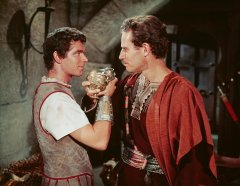
The film “Ben-Hur”, released in 2016, failed miserably at the box office
But the 1959 blockbuster was a huge success. The book it was based on is also incredibly exciting. This is Lewis Wallace’s novel Ben-Hur: A Tale of the Christ, written in 1880 after a chance meeting on a train.
Wallace’s interlocutor was Robert Ingersoll, a famous orator and atheist. The conversation turned to faith. Ingersoll’s arguments against the existence of God made a strong impression on the writer. Wallace realized that he had never really delved deeply into spiritual matters. He decided not to rush to agree with Ingersoll, but to learn as much as possible about Christianity. “Ingersoll made me ashamed of my ignorance… I decided to study the subject… Having carried out my intention, I got the result. It is, first, the novel “Ben-Hur”, and secondly, the conviction of the existence of a Creator and the divinity of Christ.”
After seven years of research, Wallace was convinced that the Gospel story about Jesus was true. Thanks to this, the book “Ben-Hur: The Story of Christ” saw the light of day.
And what do we find if we look at the life, death and resurrection of Jesus? Are we ready, like Lewis Wallace, to really think about Christ? After all, if the biblical story is true, then He really resurrected. And everyone who has returned from the world of the dead deserves to know as much about him as possible…
“And seeing a fig tree from afar, covered with leaves, He came to see if He would find anything on it.” — Mark 11:13
Cindy was excited about her new job with the charity. What an opportunity to change the world for the better! However, she soon discovered that her colleagues did not share her enthusiasm. They ridiculed the purpose of the organization and justified their poor performance by seeking more lucrative positions. Cindy regretted applying for the job. What looked great from a distance was disappointing up close.
A similar situation arose with Jesus with the fig tree, which is mentioned in today’s story (Mark 11:13). It was the beginning of the season, but the leaves on the tree indicated that it could already have early fruits. But no. The tree has not yet borne fruit. Disappointed, Jesus said: “So that no one else eats your fruit forever” (v. 14). The next morning the tree was completely dry (v. 20).
Once Christ fasted for forty days, so He knew how to do without food. The curse of the fig tree had nothing to do with His appetite. It was an object lesson. The tree represented Israel, which had the trappings of true religion, but had lost its meaning. The people planned to kill their Messiah, the Son of God. Could there be anything more barren than this?
We may look good from afar, but Jesus draws near to us, seeking spiritual fruit. Our fruit should not be spectacular. However, it must be supernatural, such as love, joy, and peace in troubled times (Gal. 5:22). By relying on the Spirit, we can even then bear fruit for Jesus.
What fruits do others see in you? How can you be more fruitful?
“You are mistaken, not knowing the Scriptures or God’s power.” — Matthew 22:29
For decades, McDonald’s dominated the fast food industry thanks to its Quarter Pounder burger. In the 1980s, a rival chain came up with the idea of dethroning the company with the golden arches. A&W offered a burger called the “Third Pound,” which was larger than a McDonald’s burger, but sold it at the same price. In addition, the A&W burger won numerous tastings. However, this idea failed. Nobody bought it. The study found that consumers got the math wrong and thought that a third of a pound was less than a quarter of a pound. A grandiose idea failed: people did not understand the basics.
Jesus warned about how easy it is to forget the basics. The religious leaders, trying to trap and discredit Him, put forward a strange, hypothetical scenario about a woman who became a widow seven times (Matt. 22:23-28). Jesus responded by saying that the problem was that the religious leaders “did not [know] the scriptures, nor the power of God” (v. 29). Scripture is not meant to answer logical or philosophical conundrums. On the contrary, its main purpose is to bring us to the knowledge and love of Jesus and to eternal life in Him (Jn. 5:39). These are the basics that leaders lacked in understanding.
We often miss the basics too. The main purpose of the Bible is our encounter with the living Jesus. And it would be very painful to miss her.
Are you missing the basics of scripture? How to get back to basics… to Jesus?
Dear God, sometimes I get lost even in the midst of good things. Please help me.
“I tell you the truth: whatever you did to one of the least of these My brothers, you did it to Me.” — Matthew 25:40
A rare case happened in the Alba family – they had two pairs of twins with a difference of thirteen months. How did they manage to combine their parental responsibilities with work? Their friends and relatives intervened in the matter. The grandparents would take in a pair of twins a day so the parents could work and pay for health insurance. One company provided a year’s supply of diapers. Colleagues of the couple donated their sick leave. “We wouldn’t be able to do it without our community,” they admitted. There was even one presenter who took off her microphone during a live interview and ran after one of their naughty kids, continuing to invest in the community!
In Matthew 25:31-46, Jesus tells a parable emphasizing that when we serve others, we serve God. After listing the acts of service, including giving food to the hungry, drink to the thirsty, shelter for the homeless, clothing for the naked, and healing for the sick (vv. 35-36), Jesus says: “Truly I say to you, whatever you did for one of the least of these My brothers, you did it for Me” (v. 40).
Perceiving Jesus as the ultimate recipient of our kindness is the true motivation for service to neighbors, families, churches, and the world. When we sacrificially invest in meeting the needs of others, we are serving Him. By loving others, we love God.
How can you serve Jesus in your community? How to love God while loving others?
Loving God, help me to see the needs of other people so that I can contribute to meeting those needs and thus love You more.
“If a grain of wheat falls into the ground and does not die, then it remains alone; if it dies, it will bear abundant fruit.” —John 12:24
We know Leonardo da Vinci as a representative of the Renaissance. His intellectual abilities led to progress in many fields of science and art. However, he wrote about “these unfortunate days of ours” and lamented that we die “without leaving behind anything in human memory.”
“While I thought I was learning to live,” said Leonardo, “I was learning to die.” He was closer to the truth than he could have imagined. Learning to die is the way to life. After His glorious entry into Jerusalem (what we now celebrate as Palm Sunday; see John 12:12-19), Jesus said: “Unless a grain of wheat falls into the ground and dies, it remains alone; but if it dies, it bears much fruit” (v. 24). First of all, He said this about His death, but then He extended it to all of us: “Whoever loves his soul will lose it, but whoever hates his soul in this world will save it for eternal life” (v. 25).
The Apostle Paul wrote about “burial” with Christ through “baptism into death, so that just as Christ was raised from the dead by the glory of the Father, so we too may walk in newness of life. For if we were united in the likeness of His death, we will also be united in the likeness of the resurrection” (Rom. 6:4-5).
Through His death, Jesus offers us a new birth, which is the essence of regeneration. He paved the way for us to eternal life with His Father.
How do you define the value of your life? How might you need to change these values?
Dear Heavenly Father, thank you that in You I can find meaning and purpose.
“Behave … well, so that … they … seeing good works, glorify God.” — 1 Peter 2:12
My seatmate on the plane told me that she is a non-religious person, but immigrated to a city where many Christians live. When she mentioned that most of her neighbors go to church, I asked about her own experience. The woman said she could never thank them enough for their generosity. When she brought her disabled father to a new country, neighbors built a ramp to her house and donated a hospital bed and medicine. “If Christianity makes people so good, then everyone should be a Christian,” she said.
The Lord Jesus told His disciples: “So let your light shine before men, so that they may see your good deeds and glorify your Father in heaven” (Mt. 5:16). Peter heard Christ’s command and passed it on: “Behave well among the Gentiles, so that for what they slander you, as if criminals, seeing good deeds, they will glorify God” (1 Pet. 2:12).
Our neighbors who do not believe in Jesus may not understand what we believe and why we believe it. Don’t worry about that, because there’s one more thing they can’t understand: the immensity of our love. My neighbor on the plane was surprised that her Christian neighbors continued to care for her, even though she was, she said, “not one of them.” She knows that she is loved because of Jesus, and she thanks God for that. She may not yet believe in Him, but she is grateful that others do.
Who do you know who needs Jesus? How can you love them for Him?