Each of us constantly makes choices. Some, at first glance, seem insignificant in our lives, while others, on the contrary, radically change everything. Some choices come quite easily, while others require serious decisions and dedication. A famous preacher once said:
“We do not choose whether to come into this world, but we do have the right to choose where to spend eternity.”
Today, I would like to talk about one important choice that can not only affect how we live our lives, but also where you and I will be in eternity.
In Matthew 23, we read the words of Christ:
“Woe to you, scribes and Pharisees, hypocrites! For you pay tithes of mint and anise and cumin, and have neglected the weightier matters of the law: justice and mercy and faith. “These you ought to have done, and not to neglect the others” (Matthew 23:23).
Jesus says this because justice, mercy, and faith are truly the most important principles in the law. Note that the Lord doesn’t say, “Stop tithing,” but points out what is most important in relation to any right human action, what actually determines the righteousness of the action itself.
Sometimes we wish there were fewer commandments to follow. But the point isn’t the number, but our attitude toward the commandments themselves. Otherwise, our lives will turn out like in the joke:
Moses is speaking with God:
— Lord, ten commandments is just too many. Let’s remove a couple? At least let there should be five?
God:
— Moses! Don’t haggle.
— What?! Where does it say “Don’t haggle”?
Let’s think about what action would be truly right:
- I forgive my offender because God commanded me to do so.
- I forgive my offender because mercy and faith in God’s mercy toward every person live in my heart.
- I do not cheat on my spouse because this is God’s commandment.
- I do not cheat on my spouse because I love him and know that God loves him too.
- I bring tithes to the house of God because God commanded it.
- I bring tithes to the house of God because I am grateful to God for His judgments, mercy, and the faith He nurtures in me.
At first glance, all actions are right (righteous), but only if you look deep into the heart of the one who commits them By examining them, one can see which of them are true, that is, committed by faith, grace, and genuine righteousness. The righteousness of any outwardly correct action can only be determined by the motives underlying it. If a person, having gathered his will into a fist, donning the straitjacket of God’s commandments, tries to fulfill them because it is necessary, or only because it might bring him some benefit and even give him Eternal Life, then all his actions will sooner or later turn out to be mere hypocrisy. Among the Pharisees and lawyers, this manifested itself in hatred for Jesus. I don’t think it will be any different for us today.
Wonderful writer Clive S. Lewis wrote:
People, not God, produced gallows, whips, prisons, slavery, bayonets, firearms, and bombs. It is human greed and stupidity, not the hostility of nature, that create poverty and toil.
All this happens precisely when we forget about fair judgment, mercy, and faith in God.
Notice that Jesus pointed out to the Pharisees that they didn’t even live by what they preached. They brought tithes and offerings to the Temple, but they didn’t follow God’s law in their daily lives. They preferred to simply obey the letter of the law.
Tithes? Here, Lord, we’ve carefully counted them out for You!
Shall we celebrate a feast? Come, Lord, we’ll conduct it according to all the rules! But we won’t apply our hearts to all of this, because we prefer to be selfish, egotistical, doing everything for our own glory.
Someone might object, but is it really necessary to make this choice? It might be enough to do the right things, but not necessarily with all our hearts? But then we’ll be like that traffic cop who ended up in eternity.
A former traffic cop ends up in eternity. An Angel stands before him and says:
“There are two roads before you: one to hell, the other to heaven. Which one will you take?” The traffic cop replies:
“Ah, may I stand at the crossroads?”
Let’s try to reflect on what the Pharisees abandoned and what is important for us not only not to abandon, but also to practice in our lives.
The first thing they abandoned was judgment.
Judgment represents God the Father. God is the righteous Judge, and without Him, a just and impartial judgment is impossible.
“The Lord judges the peoples. Judge me, O Lord, according to my righteousness, and according to the integrity that is within me. Let the wickedness of the wicked cease, and strengthen the righteous, for You search the hearts and reins, O righteous God. My shield is in God, who saves the upright in heart. God is a righteous judge, and a God who exacts strict justice all the day long…” (Psalm 7:9-12)
God is going to invade this world! But I would like to know if those who demand His open and direct intervention understand what will happen then. It will be the end of the world: when the author enters the stage, the show is over. God is going to invade, you can be sure of that. But what will be the point of claiming to be on His side then, when the familiar world will melt away like a dream before your eyes, and, crushing everything in its path, something will come that you could not even imagine – something so beautiful for some and so terrifying for others that no one will have to choose. For then God will come no longer disguised, and His appearance will be so stunning that every person will be seized by either irresistible love or irresistible terror. Then it will be too late to decide which side to take: when you can no longer stand, there is no point in saying that you have decided to lie down. This will be no time for choosing; “This will be the time when we realize which side we have actually chosen, whether we were aware of it before or not. But now we still have the opportunity to make the right choice. God waits patiently, giving us this opportunity, but He will not wait forever. We must take this opportunity or let it go.” C. S. Lewis, Mere Christianity.
This world needs God as a Judge. We also need God’s just judgment, for without it, we are more prone to condemnation.
The Scriptures tell us:
“Therefore judge nothing before the time, until the Lord comes, who will bring to light the hidden things of darkness and reveal the intentions of the hearts. Then everyone will have praise from God.” (1 Corinthians 4:5)
Judging another is much easier than understanding all the circumstances and showing forgiveness. This is why the Apostle Paul advises against judging another until we know all the circumstances. After all, if we judge based on our own assumptions or out of resentment, our judgment cannot be fair and objective and is essentially condemnation. But since we all desire forgiveness and understanding, we must act in the same way.
Mercy represents Jesus, who gave His life to save those who believed in Him. It is important for you and me to do the same, for this is the true manifestation of mercy. If we have experienced God’s mercy and forgiveness in our lives, then it is worth sharing with those who have not yet experienced it.
David, who himself experienced God’s mercy and forgiveness in his life, wrote this psalm:
“But I will sing of Your strength, and rise early to proclaim Your lovingkindness; for You have been my refuge and my stronghold in the day of my trouble. O my strength! I will sing praises to you, for God is my refuge, my God who has mercy on me.” (Psalm 58:17,18)
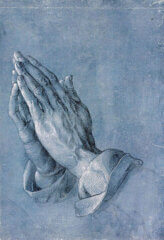 Many of you know Albrecht’s painting Durer “Hands”.
But few people know the story behind this painting. I think anyone who hasn’t seen Dürer will remember this story for the rest of their lives.
In the 15th century, in a small village near Nuremberg, there lived a family with eighteen children. Eighteen!
To support such a large family, the father, a goldsmith, worked eighteen hours a day. He worked in a jewelry workshop, but also took any paid work.
Despite their nearly hopeless situation, two children had a dream. They wanted to develop their artistic talents, but they knew their father couldn’t send either of them to study at the Academy in Nuremberg. After long, late-night discussions, the two boys struck a deal. They decided to toss a coin. The loser would go to work in the mines and use his earnings to pay for his brother’s education. Then, when the brother completed his studies, he would pay for his brother’s education in the mines by selling his work and, if necessary, by working in the mines himself.
They tossed the coin on Sunday morning, after church. Albrecht Dürer won and went to Nuremberg. Albert went to work in the dangerous mines, and for four years he paid for his brother’s education, whose work immediately became a sensation at the Academy.
Albrecht’s engravings, woodcuts, and paintings surpassed even those of many of his professors. By the time he completed his studies, he had already begun to earn a handsome sum for his work. When the young artist returned to his village, the Dürer family held a celebratory dinner on the lawn to celebrate Albrecht’s triumphant return.
After a long and unforgettable dinner, filled with music and laughter, Albrecht rose from his place of honor at the head of the table to raise a toast to his beloved brother, who had sacrificed so many years to fulfill Albrecht’s dream. At the end of his speech, he said, “Now, Albert, my blessed brother, your turn has come. Now you can go to Nuremberg to pursue your dream, and I will take care of you.”
Everyone turned expectantly to Albert, who sat at the other end of the table. Tears streamed down his pale face, and he shook his head, sobbing and repeating, “No… no… no… no.” Finally, he stood and wiped away his tears. He looked at the faces of the people he loved so much, and then, raising his hands to his face, he said softly, “No, brother. I cannot go to Nuremberg. It’s too late for me. Look! Look what these four years in the mines have done to my hands! The bones in every finger have been broken at least once, and recently I’ve developed arthritis in my right hand. I can’t even hold a glass for a toast, much less draw beautiful lines on parchment or canvas with a pencil or brush.
No, brother, it’s too late for me.” More than 450 years have passed. Now, hundreds of portraits, pen and silverpoint drawings, watercolors, charcoal drawings, woodcuts, and copperplate engravings hang in every great museum in the world. Chances are, you’re familiar with at least one work by Albrecht Dürer. Perhaps you also have a reproduction of one of his works hanging in your home or office.
One day, to honor Albert for all his sacrifice, Albrecht painted his brother’s calloused hands, reaching toward the sky. He called his painting simply: “Hands.” But the whole world almost immediately opened their hearts to this masterpiece and called it “Praying Hands.”
What was the grace in this story? One brother was willing to sacrifice his dream so that his brother’s could come true. There is grace in this, grace that cannot be earned, but can only be given to another.
Speaking of grace, I want to tell you a parable:
A man died and went to Heaven. An angel met him at the pearly gates and said:
— “To pass through these gates, you must score 100 points.” You tell me all the good deeds you’ve done on earth, and I’ll tell you how many points you scored.“Good,” said the man, “I’ve been with my wife for fifty years and have never cheated on her, not even in my heart.”
— “Oh, that’s wonderful!” said the angel. “For that, you get a full three points!”
— “Three points?!” the man was amazed. “Well, fine, I’ve gone to church my whole life, tithe regularly, and participated in services.”
— “Excellent!” said the angel. “That’s worth two points.”
— “Only two?!” the man exclaimed.
— “Well, what do you say about this: I organized a soup kitchen and worked in a nursing home.”
— “Fantastic!” “That’s worth a four,” said the angel.
— “Four?!” the man cried out in despair. “Well, in that case, you can only get to Heaven by God’s grace!!!”
— “Come in!”
We all need God’s grace just as much as those around us need our grace toward them.
That’s why the Apostle James says: “For judgment will be without mercy to him who has shown no mercy; mercy triumphs over judgment.” (James 2:13)
Faith represents the Holy Spirit. It is given to all who believe in Christ. It is the Holy Spirit who reveals to us who Jesus is and what He has done for us. It is the Holy Spirit who gives us the ability not only to believe in God but also to bestow upon us various gifts for serving Him.
“Therefore I tell you that no one speaking by the Spirit of God will pronounce Jesus accursed, and no one can say that Jesus is Lord except by the Holy Spirit.” (1 Corinthians 12:3)
Faith is essential in our relationship with God, and it plays a vital role in our relationships with those whom God has placed in our lives. It is faith that will help us discern God’s answers amid trials and understand how we can serve others.
A well-known story is that of how, through the faith of four friends, a paralytic received forgiveness of sins and healing. I have personally heard sermons about these four many times.
But today, I’d like to draw your attention, and mine, to the paralyzed man.
He couldn’t walk.
Most likely, he couldn’t even just walk, but also feed himself and care for himself.
He probably couldn’t speak. We see that Jesus didn’t ask him anything (He usually spoke to everyone who came to Him with a need).
Let’s imagine his condition for a second…
Let’s ask ourselves: how many of my friends would be there for me if I were in this condition? If I couldn’t bless them, help them, preach to them, or instruct them, who wouldn’t forget me? Who could carry me in their arms in prayer to Jesus?
The answer to these questions directly depends on the quality of my relationships with my friends. How much I personally invest in these relationships.
If this paralyzed man’s four friends didn’t forget him, if they went to such extreme measures: tearing up someone else’s roof, being prepared to be disgraced, being expelled from the synagogue…
Then they had good reasons. I am convinced: this paralyzed man knew how to be a friend and had done much good for them before. He invested in these relationships long before the problem arose. His faith was demonstrated in his loyalty to his friends, and in time, his friends repaid him with the same loyalty. It was by their faith that this paralyzed man received salvation and complete healing.
A simple wish for everyone this year: “Know how to be a friend!” Be faithful to God and your neighbors. This can play a key role in your life.
In conclusion, I would like to read with you verse 20 of chapter 5 of the Gospel of Matthew. In it, Jesus addresses the people listening to Him:
“… I tell you, unless your righteousness exceeds that of the scribes and Pharisees, you will in no way enter the kingdom of heaven.” (Matthew 5:20)
Jesus doesn’t abolish the righteousness of the scribes and Pharisees. He doesn’t suggest that we should stop respecting the Law, but rather affirms the idea that if all our righteousness is as hypocritical and ostentatious as theirs, we will not be able to enter the Kingdom of Heaven. Our righteousness must include something more than the letter of the law… namely, judgment, mercy, and faith, which come to a person only in one case: if a person truly loves the Lawgiver.
It is important for us to maintain judgment, mercy, and faith in our lives — they are the ones that will help us live as the Lord desires. And most of all, it is important for us to love the Lawgiver! Only He can help us appreciate His righteous judgment, undeserved mercy, and the faith that will help us move mountains.